

We checked it against the latest population data. The short answer might annoy a few people at the next dinner party.
Few bits of folk wisdom have stuck around quite like Australia’s “man drought”: the idea that single women so badly outnumber single men that finding a decent bloke is a numbers game you’ve already lost. It gets trotted out at dinner parties, in newspaper columns and across a thousand group chats. So we did the unromantic thing and checked it against the most recent figures from the Australian Bureau of Statistics. The verdict? As it’s usually told, the man drought is mostly a myth.
The numbers are near even
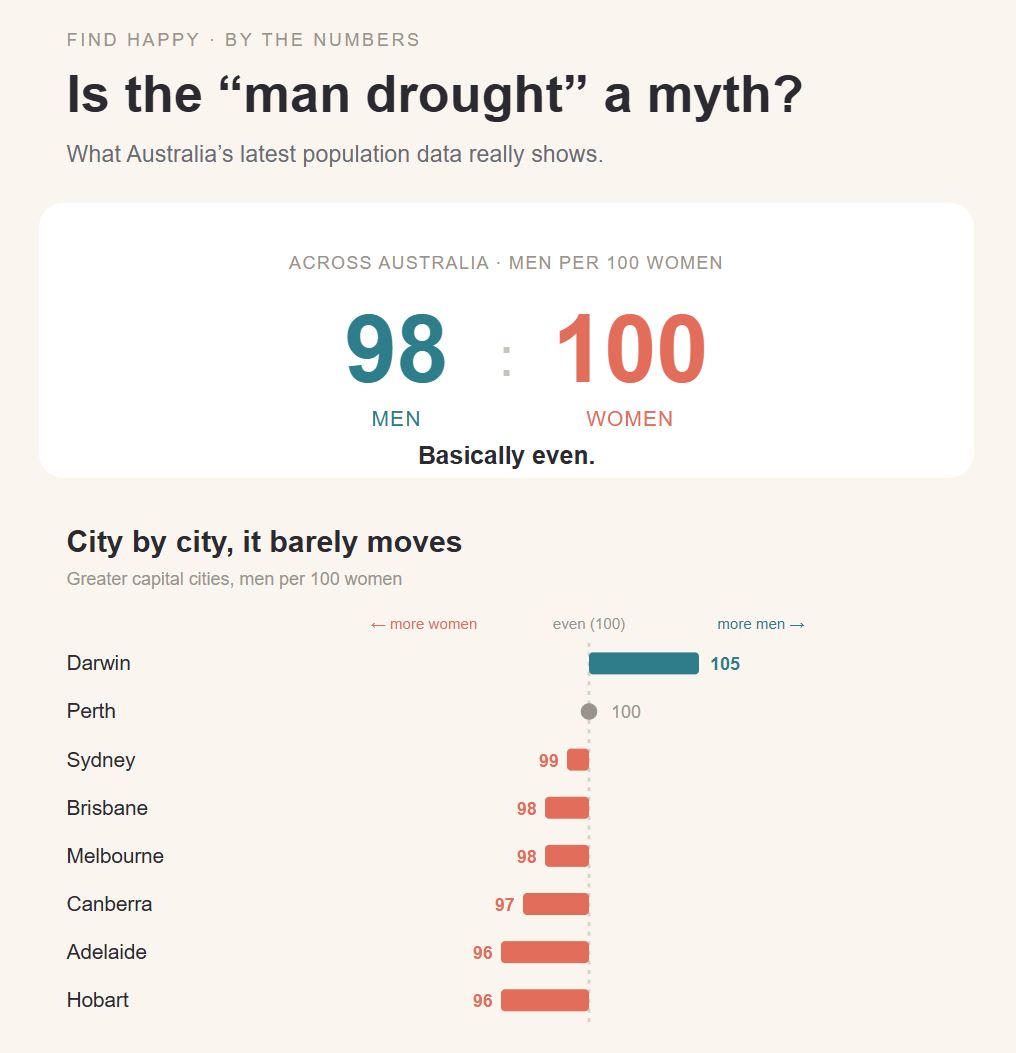
Across Australia there are about 98 men for every 100 women. That works out to roughly 200,000 more women than men in a country of nearly 27 million. Real, but tiny. Calling it a drought is a bit like calling a damp Tuesday a flood.
There’s a twist, too. We’re actually born with more boys, around 106 for every 100 girls, year after year. Men just don’t hold onto the lead. They’re more likely to come unstuck at every age that follows, and women live longer, so the balance only tips toward women later in life. The shortfall, such as it is, sits mostly at the older end.
City by city, the needle barely moves
Look capital by capital and there’s not much drama. Darwin is the one city with more men than women, and it’s also the youngest capital in the country. Everywhere else lands just on the female side of even. Sydney, Melbourne, Brisbane and Perth all sit in the high 90s, while Adelaide and Hobart have the fewest men of the capitals, and even they’re only a few points below even. Wherever you live, the dating maths is close enough that it tells you almost nothing about your own chances.
So where did the idea come from?
Here’s the fair part, because the myth didn’t appear from nowhere. There’s a kernel of something real underneath it, just not the thing people usually mean.
The serious version of the argument was never about the whole population. It’s about the pool of single, available people of a similar age, and there things can genuinely get lopsided. Men tend to partner slightly younger. Women now outnumber men at university, which scrambles the old “marriage market.” And because women live longer, the higher you go up the age range, the more the balance tilts. Put those together and a woman in her late thirties or forties looking for a similar-aged, single, available man can absolutely feel a squeeze, even while the national headcount sits at near enough even.
The honest catch is that the population figures everyone quotes can’t prove or disprove that. To test it properly you’d need to count single people by age, not the whole country. So the next time someone declares the man drought alive or dead over dinner, the correct answer is that it depends entirely on which numbers they’re holding.
The real extremes are funny, not romantic
What the data does show, gloriously, is that the genuine extremes have nothing to do with love lives. The most male places in Australia are mining regions and towns built around prisons. One mining area in Western Australia runs at about 272 men for every 100 women, which sounds like a jackpot until you remember why. At the other end, the most female-heavy spots aren’t nightclubs or beaches. They’re leafy, well-off, older suburbs, led by Woollahra in Sydney’s east at around 81 men per 100 women. The driver there is mostly age and money, not romance.
So the blokes are out by the mines, the women are in the smart postcodes near the water, and neither group is there for the dating.
The verdict
The man drought is a brilliant pub fact built on a small, mostly age-related gap, and a poor guide to anyone’s actual love life. The truth is duller and kinder: across most of the country, and especially in the cities where most single people live, it’s near enough even.
And in any case, you never date a national average. You date in your suburb, in your age group, among people who are single and genuinely looking. That’s the whole idea behind Find Happy: real singles near you in Sydney, Melbourne, Brisbane, Perth, Adelaide and beyond, rather than a spreadsheet. Drought or not, it always comes down to one person at a time.
Figures from the Australian Bureau of Statistics, Regional population by age and sex, 2024, and ABS births data. “Sex ratio” means the number of men per 100 women.